Wieman's

Landmark Contributions

Creation of the First Bose–Einstein Condensate (BEC)
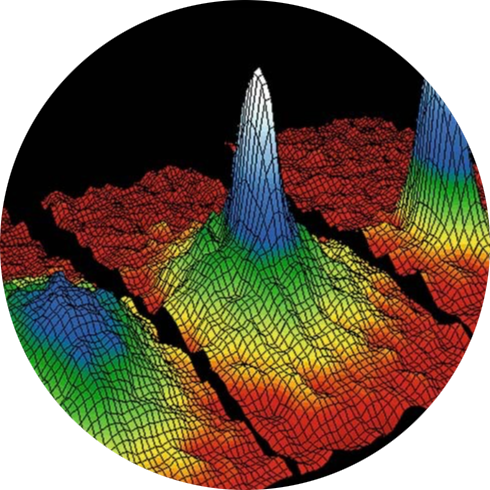
In 1995, Prof. Carl Wieman and Eric Cornell created the world’s first Bose–Einstein Condensate (BEC) using rubidium-87 atoms cooled to just 170 nanokelvin—a temperature unbelievably close to absolute zero. At such extreme cold, atoms lose their individual identities and “collapse” into a single quantum state, behaving like one giant super-atom governed entirely by quantum mechanics.

Why this is monumental:

  • It proved the 70-year-old prediction by Bose and Einstein (1924–25).

  • It opened up a new frontier in physics where researchers can directly observe and study quantum phenomena on a macroscopic scale.

  • It revolutionized atomic, molecular, and optical physics and paved the way for technologies such as ultra-precise sensors, quantum simulators, and atom lasers.

This achievement earned Wieman the 2001 Nobel Prize in Physics and is considered one of the most important experimental breakthroughs of the 20th century.

Development of Advanced Laser Cooling and Trapping Techniques

Prof. Carl Wieman played a key role in advancing laser cooling and magnetic trapping methods that made it possible to reach temperatures only billionths of a degree above absolute zero. These innovations allowed atoms to be slowed, confined, and manipulated with unprecedented precision.

Why this matters:

  • These cooling techniques created the experimental pathway that made the first Bose–Einstein Condensate (BEC) possible.

  • They enabled scientists to study quantum behavior in a controlled environment, atom by atom.

  • The methods became foundational in modern ultracold atomic physics, influencing quantum optics, precision measurements, and quantum information science.

In essence, Wieman’s work on laser cooling didn’t just support BEC creation—it transformed the entire field of experimental atomic physics.

Pioneering Experiments on Quantum Behavior in Ultracold Gases
After creating the first Bose–Einstein Condensate, Prof. Carl Wieman conducted groundbreaking experiments that revealed how atoms behave collectively in quantum states. By studying ultracold rubidium gases, his team observed phenomena that had previously been purely theoretical.

Key insights from his work:

  • Demonstrated how atoms in a BEC move together as a single quantum wave.

  • Showed the transition from classical to quantum behavior in real time.

  • Revealed unique properties such as anisotropic expansion, quantum interference patterns, and macroscopic quantum coherence.

  • Helped establish BECs as a powerful platform for exploring fundamental physics, from superfluidity to quantum phase transitions.

Wieman’s experiments provided the first direct experimental window into many-body quantum physics and shaped the rise of modern ultracold atom research.

Precision Measurements and Tests of Fundamental Physics Using Ultracold Atoms
Prof. Carl Wieman used ultracold atoms—notably those in Bose–Einstein condensates—to perform extremely precise measurements that test the limits of quantum theory and atomic physics. Because ultracold atoms move incredibly slowly, they allow scientists to measure physical properties with extraordinary accuracy.

Why this contribution is important:

  • Ultracold atoms provide an ideal system to test quantum mechanics and atomic interactions with minimal thermal noise.

  • Wieman’s work enabled high-precision determinations of atomic constants and interaction strengths (e.g., scattering lengths).

  • His techniques improved the accuracy of atomic clocks, magnetometers, and other high-precision instruments.

  • These methods helped validate and refine theoretical models in quantum many-body physics.

Overall, Wieman’s precision experiments demonstrated how ultracold atoms can serve as a microscope for fundamental quantum laws, advancing both theory and experimental methodology.

Foundational Contributions to Physics Education Research (PER)

Prof. Carl Wieman revolutionized science education by applying the rigor of scientific research to the classroom. Instead of relying on traditional lectures, he conducted controlled, data-driven studies to understand how students actually learn physics. His work demonstrated that active learning, interactive engagement, and real-time feedback significantly improve student comprehension compared to passive listening.

He also founded the widely acclaimed PhET Interactive Simulations, which bring complex scientific concepts to life and are now used globally by millions of learners. Through his research, programs, and policy leadership, Wieman transformed PER into an evidence-based discipline, influencing universities worldwide and reshaping modern STEM education.

and many more…